Agentic SDLC

Software delivery,
run by agents.

Give Codepixel a requirement. It understands your system, creates the plan, breaks work into tickets, runs coding agents in parallel, tests the output, and prepares the release — while your engineers approve the decisions that matter.

Your repository Bring your own model keys Human approval gates Private deployment available
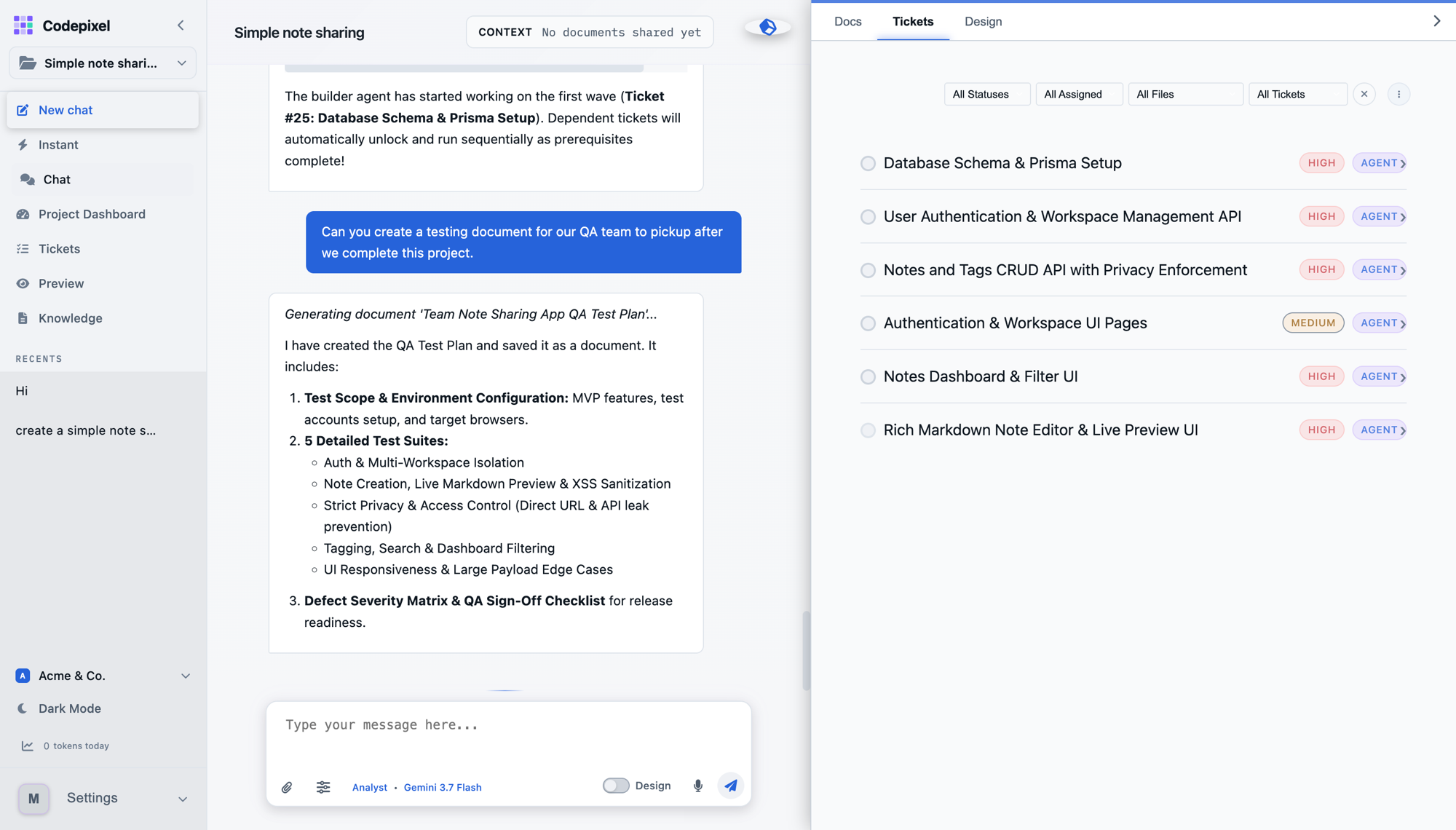
A Codepixel project's ticket list, with status, priority and tags
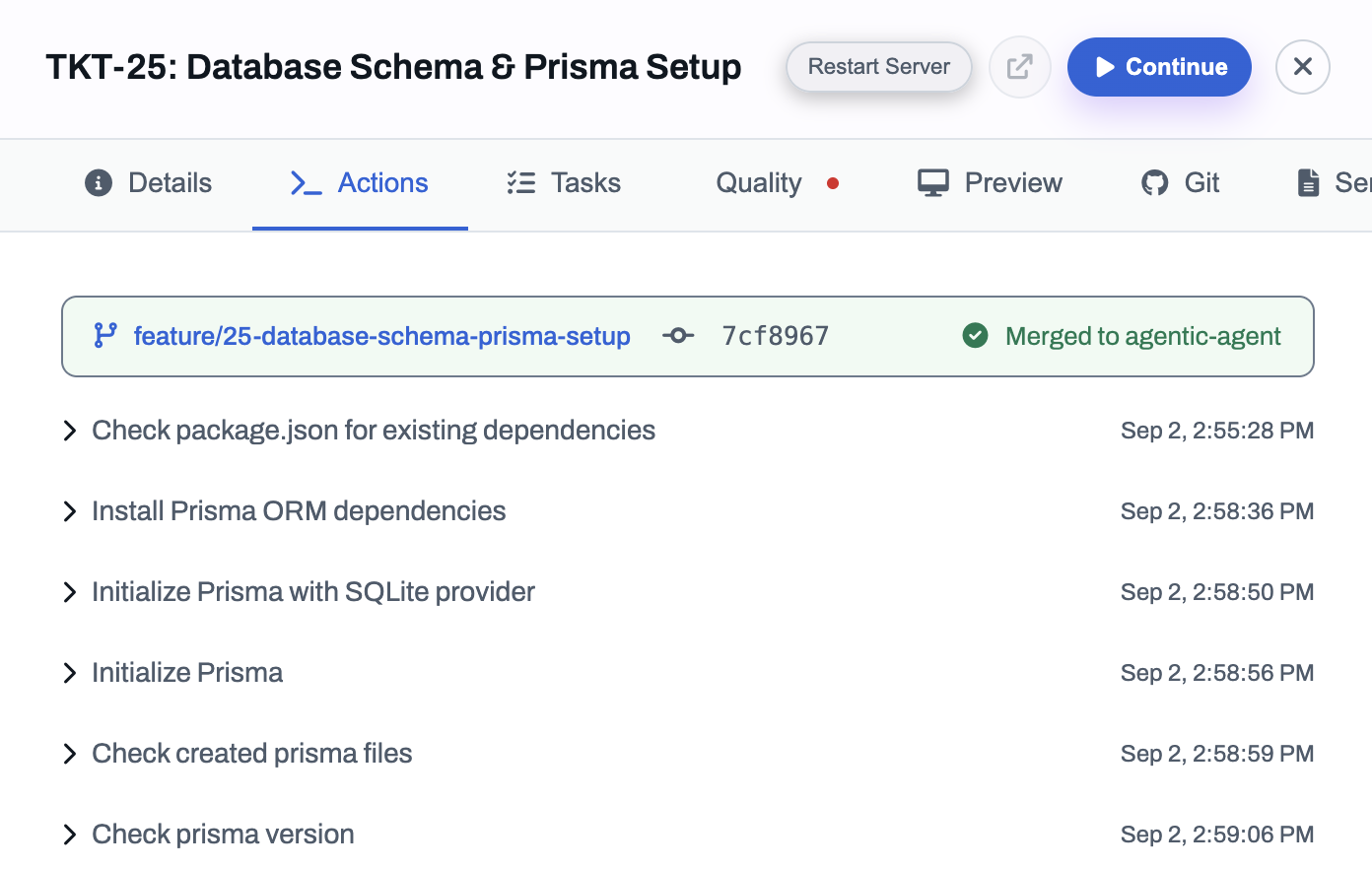
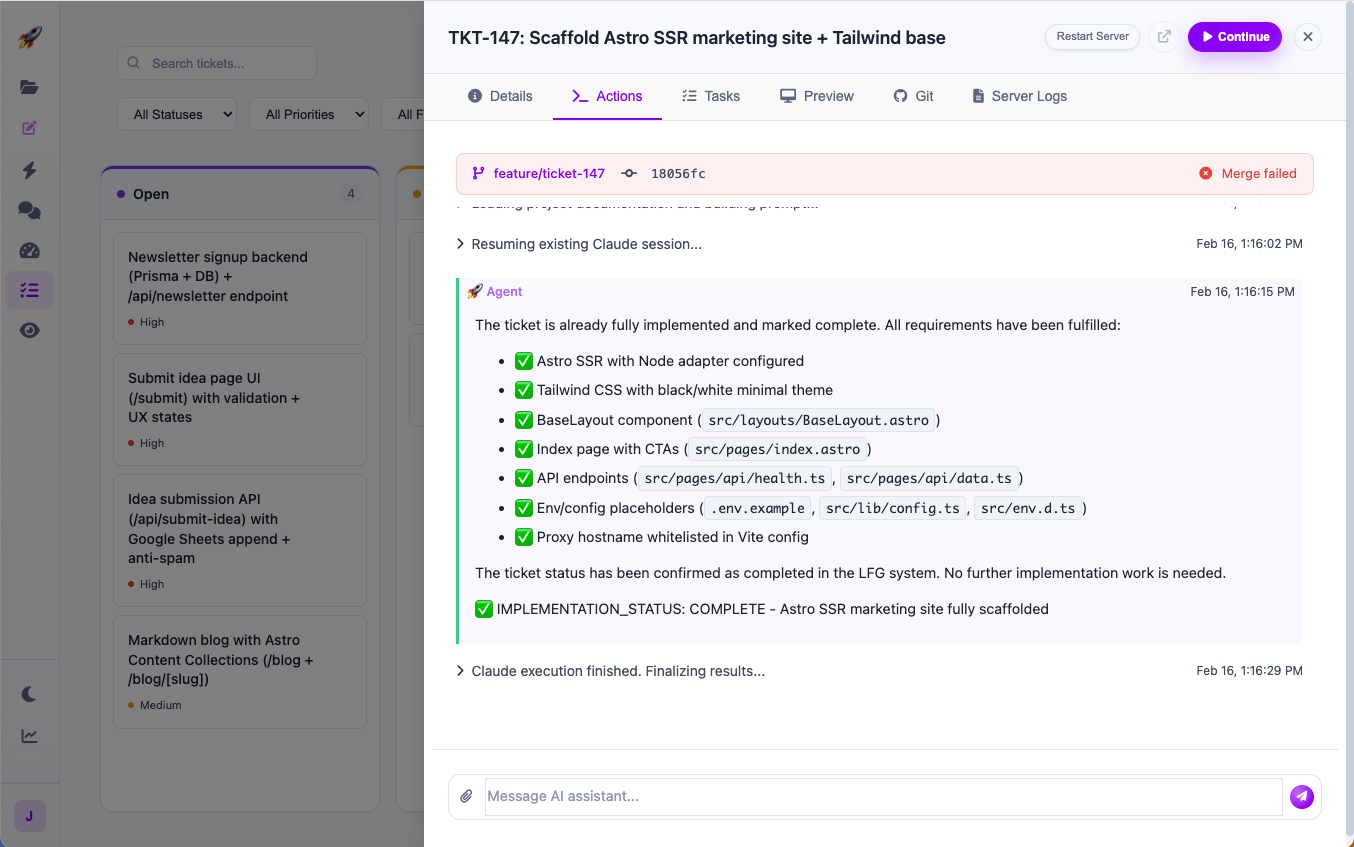
An agent working through a ticket, step by step, ending in a completion status
Model agnostic — bring your own keys
Claude
OpenAI
Gemini
The factory

From requirement to release.

Every stage produces something your team can inspect. Agents handle volume. Humans keep control.

01

Requirement

Business goal, scope and existing system context.

Context indexed
02

Plan

PRD, acceptance criteria and technical analysis.

Agent running
03

Architecture

Implementation strategy, dependencies and risks.

Engineer gate
04

Tickets

Dependency-aware execution graph ready for agents.

14 queued
05

Build

Parallel coding sessions in isolated branches.

6 agents active
06

Verify

Tests, QA, acceptance checks and automatic rework.

31 / 34 passed
07

Release

Review-ready PR, documentation and release trail.

Awaiting sign-off

Start with one requirement.

Run it end to end and compare against your current process.

Run a pilot
Why Codepixel

Writing the code was
never the slow part.

Generation stopped being the constraint. What still takes a week is everything around it — and that is what Codepixel automates.

Working with a coding assistant

Starts fromA prompt you write
Knows aboutWhat fits in one session
Works onThe file in front of it
RunsOne task at a time
Checked byYou, in review
ProducesA diff
Held together byYou

Codepixel

Starts fromA business requirement
Knows aboutThe PRD, design and spec, on every ticket
Works onA dependency-ordered plan
RunsMany agents, in isolated workspaces
Checked byA gate, against the acceptance criteria
ProducesPlan, tickets, code, tests, preview, PR
Held together byThe system — you hold the gates
Where the time actually goes

Ten steps to ship.
Codepixel runs nine.

An assistant changes one of them. Codepixel takes the other nine and leaves you the review.

Step On an AI-assisted team With Codepixel
Understand the requirement AI-assisted An engineer reads it and decides what it means Codepixel Becomes a PRD with acceptance criteria, for you to approve
Gather the context AI-assisted An engineer finds the code that matters Codepixel Attached to every ticket and read at build time
Decide the approach AI-assisted An engineer settles it, usually in their head Codepixel A written technical spec, for you to approve
Break it into work AI-assisted Someone writes the tickets by hand Codepixel A ticket graph, generated from the spec
Sequence it AI-assisted A lead keeps track of what is blocked Codepixel Dependencies sit on the tickets; blocked work starts itself
Write the code AI-assisted An assistant genuinely helps here Codepixel Agents build in parallel, in isolated workspaces
Verify it AI-assisted An engineer runs it and eyeballs the result Codepixel A gate runs the tests and the acceptance criteria
Deal with failures AI-assisted An engineer re-prompts and tries again Codepixel The gate hands the ticket back to the agent to fix
Review AI-assisted An engineer reviews everything, passing or not Codepixel You review work that already passed
Ship it AI-assisted An engineer prepares the change for merge Codepixel A pull request on your branch, with the trail attached
Highlighted is the single step an assistant already changes. Review stays yours — everything else is carried for you.
Where coding agents fit

The agent is the engine.
Codepixel is the factory.

An agent is very good at what you point it at. Codepixel decides what to point it at, what “done” means, and what has to happen first.

It starts a level earlier

The input is a requirement, not a prompt. Codepixel writes the PRD and the acceptance criteria first, so there is something concrete to build against and to check against later.

Context outlives the session

The PRD, the design system and the technical spec are attached to each ticket and read at build time. Nothing depends on one long conversation staying in memory.

Many agents, in the right order

Tickets carry their dependencies. Independent work runs at the same time in separate workspaces; dependent work waits and starts on its own when the ticket it needs has passed.

Something checks the work

A quality gate runs the tests and the acceptance criteria before a human sees the change. When it rejects, the ticket goes back to the agent to fix — not onto your review pile.

Better coding models make this better, not redundant.

Codepixel is model-agnostic on purpose. The planning, sequencing, verification and audit trail stay the same whichever model writes the code — so every improvement in coding models lands inside a process that already knows what to do with it.

See the pipeline
Built into the pipeline

Work you can watch happen.

Requirements, tickets, agent runs, diffs, tests, failures and approvals stay visible while the work is happening.

An agent executing a ticket, with live logs
Execution

Parallel agent work, in isolated branches.

Runs coding agents in isolated environments and parallelizes work wherever dependencies allow — then checks tests, application behavior and the original acceptance criteria before anything reaches a reviewer.

  • Code, commits and working previews
  • Test results and QA reports
  • Automated rework when checks fail
  • Pull request, documentation and release trail
Model agnostic

Use the best model for each job.

Bring your own keys or use a managed setup. Switch models on capability, compliance or cost — the process stays the same.

  • Works inside your existing Git workflow
  • Agent jobs run in isolated workspaces
  • Requirements, tests and reviews stay queryable
Claude
OpenAI
Gemini
Enterprise fit

Configured around how your company ships.

Not a fixed workflow. Configure it around your systems, policies, approval chain and deployment environment.

Custom integrations

GitHub, GitLab, Bitbucket, Jira, Azure DevOps, CI/CD, security scanners and internal systems.

Custom gates

Architecture review, security sign-off, QA, UAT, change management or client approval.

Custom agents

Specialized agents for your frameworks, standards, domains and engineering practices.

Private deployment

Dedicated cloud, customer VPC or stricter self-hosted patterns for sensitive environments.

Control without babysitting

Not a black box.

Every requirement, ticket, agent run, diff, test and approval stays visible while the work is happening.

TraceableEvery change maps back to a requirement and acceptance criteria.
InspectableLogs, diffs, previews and failures stay visible.
GovernedHumans remain at the gates that carry real consequence.

Your repositories

Codepixel works inside your existing Git workflow. Your source stays yours.

Approval gates

Decide exactly where an engineer must review before work moves forward.

Isolated execution

Agent jobs run inside isolated workspaces rather than directly on production systems.

Audit trail

Requirements, plans, tickets, commits, tests and reviews remain queryable.

Your questions, answered

Before you start.

What engineering teams ask before running their first real requirement.

Does Codepixel work with our repository? +

Yes. Codepixel works inside your existing Git workflow, and your source stays yours.

Where does the agent actually run code? +

Agent jobs run inside isolated workspaces rather than directly on production systems.

How do our engineers stay in control? +

You decide exactly where an engineer must review before work moves forward. Humans remain at the gates that carry real consequence.

Which models can we use? +

Bring your own keys or use a managed setup, and switch models based on capability, compliance or cost without rebuilding your delivery process.

Can it run in our own environment? +

Dedicated cloud, customer VPC and stricter self-hosted patterns are available for sensitive environments.

How do we evaluate it properly? +

Give us one real requirement, feature or backlog item rather than a demo, and compare delivery time, engineering effort and quality against your current process.

Start with one real project

Don’t evaluate Codepixel on a demo.

Give us one real requirement. Compare delivery time, engineering effort and quality against your current process.

Real repository Real acceptance criteria Measurable before/after